
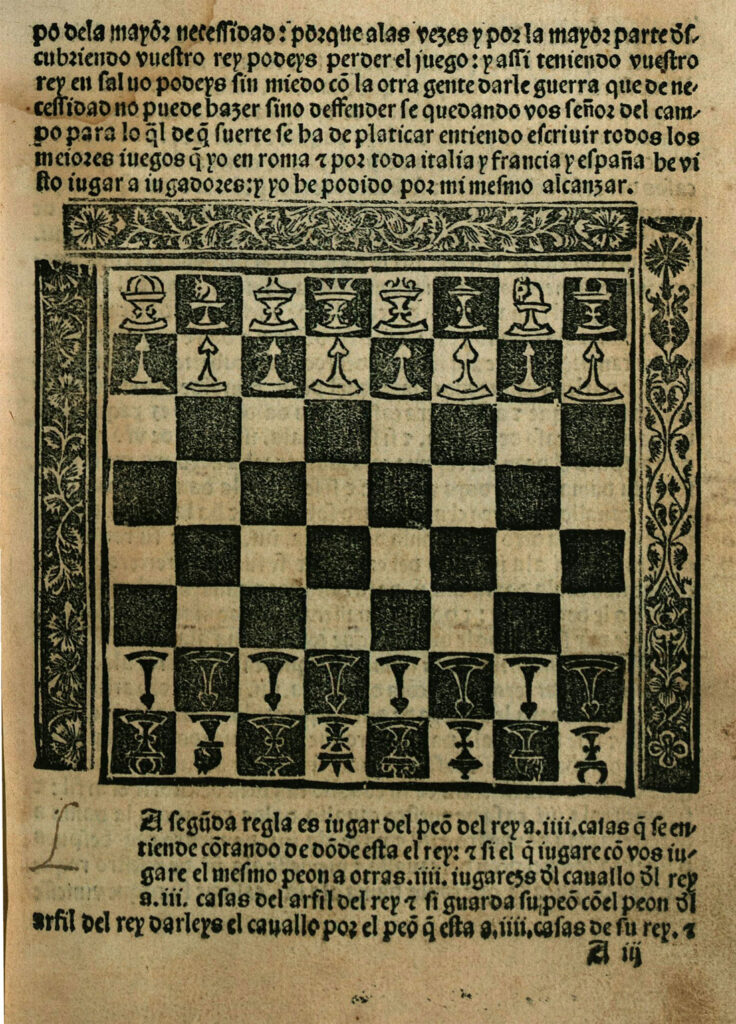
A Cross-Cultural Gateway: The Revolution Codified by Lucena
Published in 1497, this work is the oldest surviving printed document marking the transition of chess into the modern era. The author’s father, Juan Ramírez de Lucena, was a prominent diplomat and a “converso” (a person of Jewish descent) in the service of the Catholic Monarchs. This multicultural family background served as a vital intellectual conduit, facilitating the flow of knowledge from the Mediterranean, North African, and Middle Eastern basin into Europe.
In this work, Lucena acts not as an inventor but as a masterful compiler and codifier. The transformation of the advisor (queen) chess piece from a restricted figure into the most powerful force on the board had already blossomed as an allegory of love in poems like the 1475 Scachs d’amor long before Lucena. By likely drawing from (and copying) the lost 1495 texts of Francesch Vicent, Lucena utilized the power of the printing press to universalize these “new game” rules that were already echoing in the streets and in poetry. This book stands as the first constitution of the shift from the slow tempo of ancient Shatranj to the dynamism of modern chess.
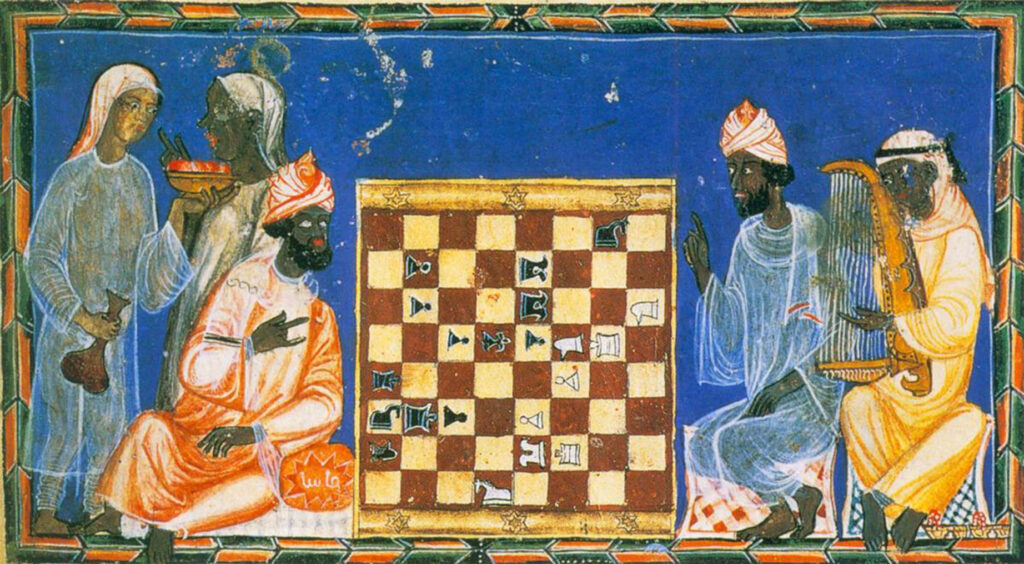
A Kingdom’s Shared Intellect: Europe’s First Encyclopedia of Games
Dated 1283, the Libro de los Juegos (Book of Games) is the first and most comprehensive encyclopedia of gaming culture in Europe. Commissioned by King Alfonso X of Castile, this manuscript is the grandest record of chess’s millennium-long journey from Persia through the Mediterranean, North African, and Middle Eastern basin into Europe. The book presents chess not merely as a pastime but as a simulation of the universe, intertwined with astrology and mathematics. Its more than 150 miniatures immortalize the civilized dialogue of people from different faiths, women, and scholars meeting around the same table, using secular and abstract pieces. This work stands as the most brilliant evidence from the Middle Ages that intellect is a bridge that transcends all beliefs.