
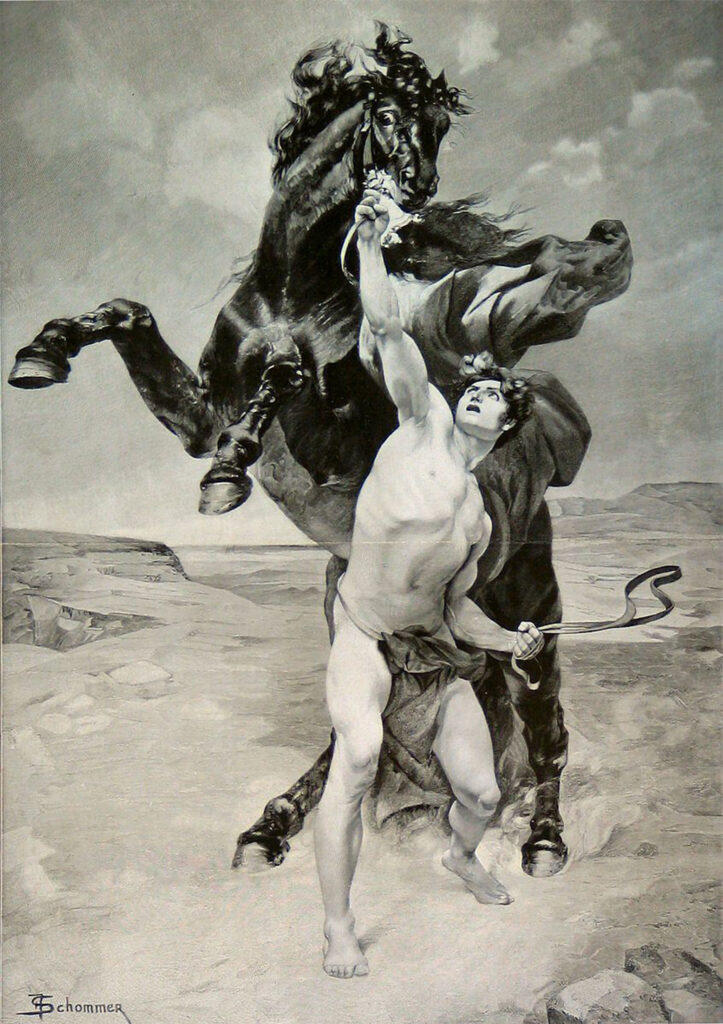
Meaning “Ox-headed” (Boukephalos) in Ancient Greek likely due to his broad brow or a branding on his shoulder Bucephalus is the most iconic warhorse in history. Legend tells that he was offered to King Philip II by Philonicus the Thessalian for the staggering sum of 13 talents, yet no one could tame his wild spirit. A young Alexander, observing that the horse was merely frightened by his own shadow, turned him toward the sun to calm him. Upon seeing this, King Philip famously declared: “O my son, look thee out a kingdom equal to and worthy of thyself, for Macedonia is too little for thee!”
From Battlefields to Immortality
Bucephalus accompanied Alexander throughout his entire campaign from Greece into the heart of India. He bore his master through the bloodiest of clashes, from Granicus and Issus to Gaugamela and the Battle of the Hydaspes. In 326 BC, during the Indian campaign, he passed away either from battle wounds or old age (at nearly 30). In his honor, Alexander founded the city of Alexandria Bucephala on the banks of the Jhelum River in modern-day Pakistan.
Cultural Legacy
In the history of art and literature, Bucephalus stands as a symbol of power, loyalty, and keen instinct. In Eastern traditions, where Alexander is often identified as “Iskandar,” Bucephalus is portrayed as a loyal companion endowed with supernatural qualities. He remains the true “spirit” behind history’s greatest conqueror, representing a bond that transcended the battlefield.