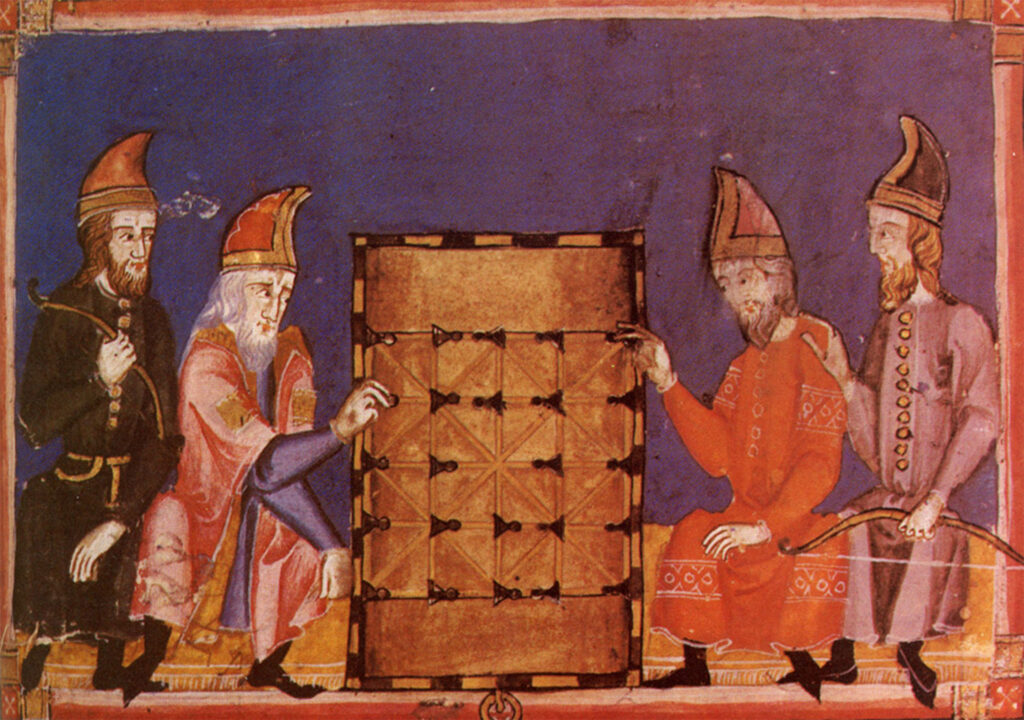
Alquerque: The Ancient Ancestor of Draughts and the Legacy of Alfonso
A Strategy Stretching from Castile to the Present Commissioned in 1283 by King Alfonso X of Castile (Alfonso the Wise), the Libro de los Juegos (The Book of Games) remains the most comprehensive record of gaming culture in Medieval Europe. Alquerque, detailed within its pages, is the European evolution of an ancient strategy game known in the Arab world as “El-Qirkat,” with roots tracing back to ancient Egypt. In 13th-century Spain, Alquerque stood as a testament to how Christian, Muslim, and Jewish scholars collaborated to bridge the knowledge of the East with the West.
The Path to Draughts Played with 12 pieces each on a 5×5 grid, Alquerque is the birthplace of the “jumping capture” mechanic, which is the core rule of modern Draughts. In the late 15th century, when these dynamic rules were transferred onto the 8×8 chessboard, the game of “Draughts” (Checkers) as we know it today was born. This depiction serves as proof that games are not merely pastimes, but a universal language connecting geographies, languages, and faiths