
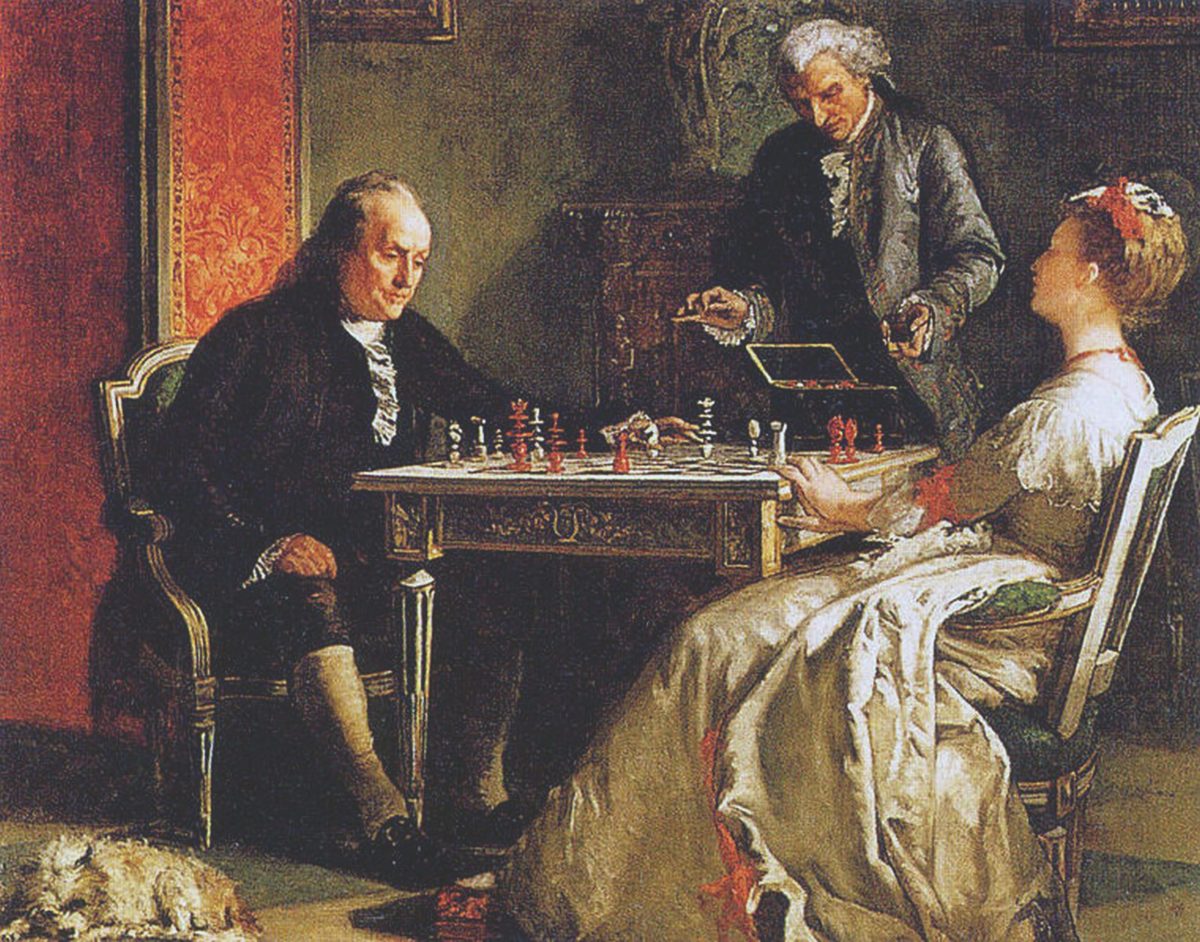
Benjamin Franklin’s 1786 essay, “The Morals of Chess,” redefined the game as a vital tool for personal development and intellectual virtue. Franklin believed that chess was more than a pastime; it was an exercise in foresight, circumspection, and caution—qualities he deemed essential for success in both private life and public diplomacy. Throughout the Age of Enlightenment, Franklin frequented celebrated chess cafes like the Café de la Régence in Paris. These spaces served as the original social networks of the era, where the game facilitated rigorous debates and the exchange of revolutionary ideas, bridging the worlds of science, politics, and philosophy.
Franklin’s fascination with the game’s intellectual limits led him to a historic encounter with the Mechanical Turk, the world’s most famous chess-playing automaton. During a 1783 match in Paris, Franklin tested his skills against the machine, which exemplified the Enlightenment’s obsession with mechanical reason. The Turk eventually traveled to the United States and found its final home in the Peale Museum (and later the Chinese Museum) in Philadelphia. It remained a staple of Pennsylvania’s scientific culture for decades before being lost in a fire in 1854. This legacy of human ingenuity and machine intelligence remains a foundational story for exhibitions exploring the intersection of history, games, and the evolution of intelligence.
The photo depicts Benjamin Franklin playing chess. Artwork by Edward Harrison May, 1867